The Forum Doesn't Remember, and Doesn't Cumulate
The Second Renaissance sees more and more contribution, and almost none of it accumulates into understanding the movement can use together. Why, and what we could do about it.
Meet Maren, twenty-three, a student in Gothenburg. She joins the Second Renaissance forum and posts a comment:
The Second Renaissance theory of change seems to float free of any actual place. You should start in a neighbourhood somebody actually lives in.
Nine people reply. It is a good conversation.
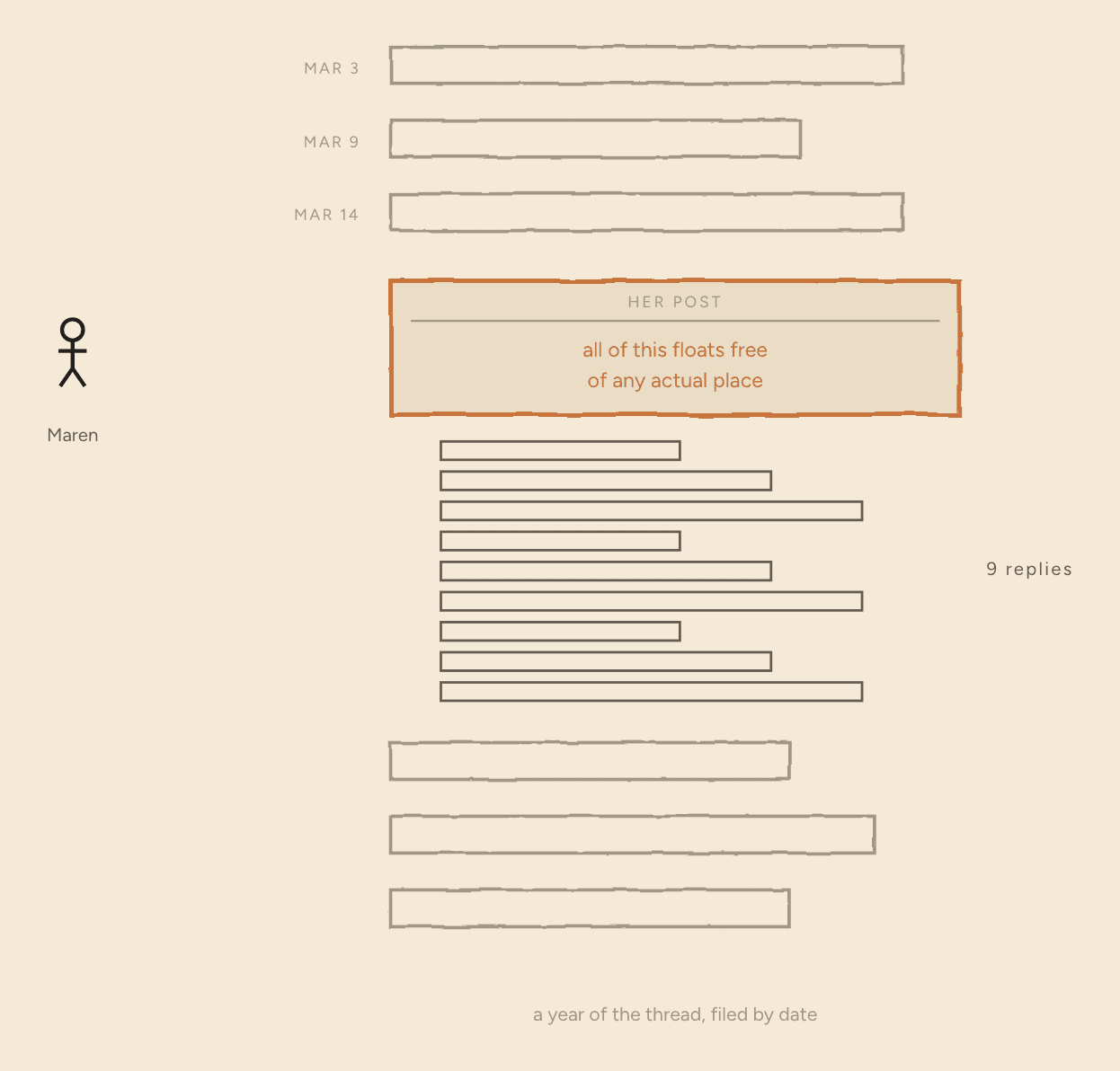 Her post arrives in the thread, and gathers nine replies.
A year later, nothing in the Second Renaissance theory of change is any different because of it.
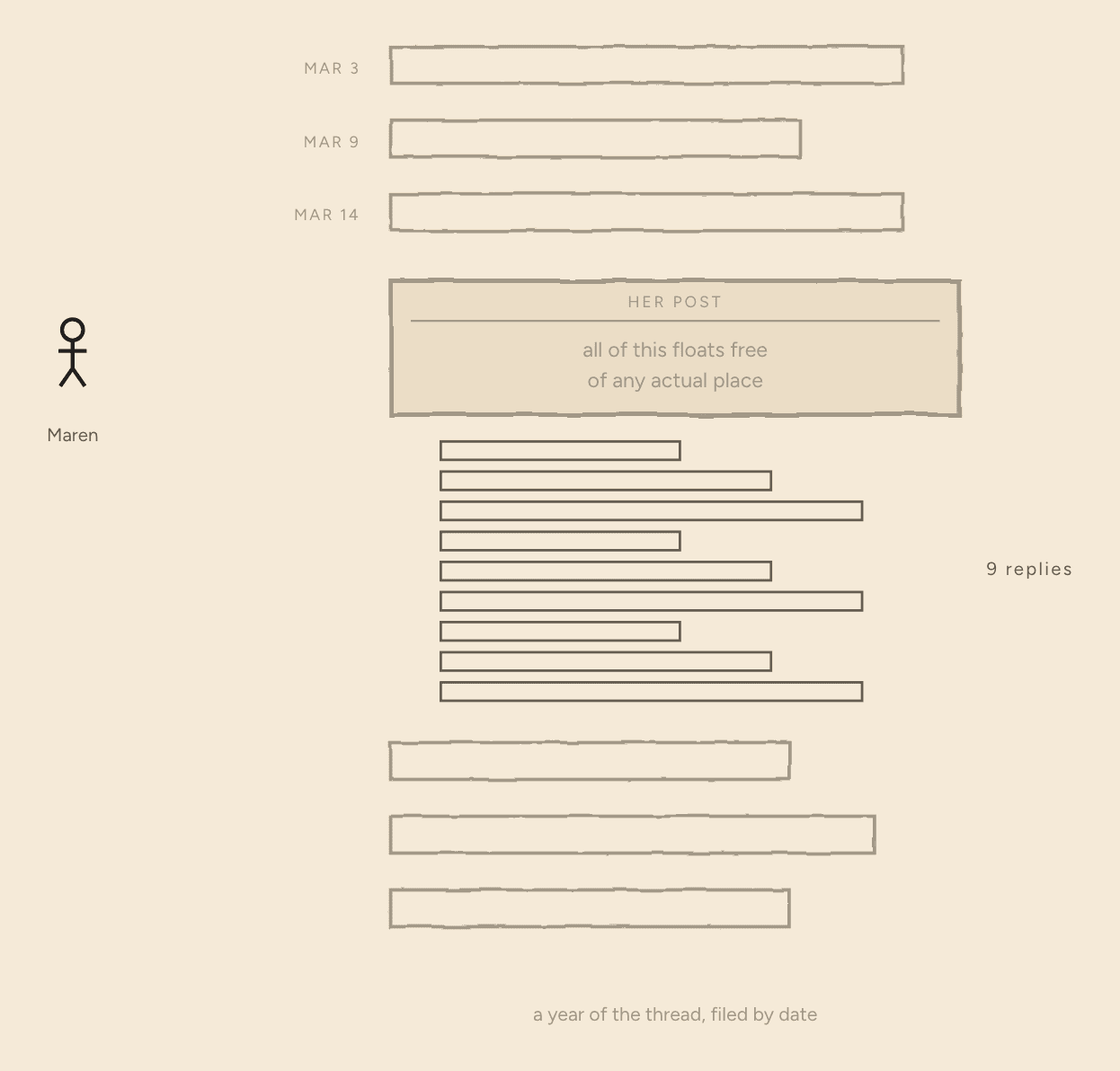 The same column, a year on. Her post is just another grey bar in the run, and the theory of change hasn't moved.
The Second Renaissance is a movement for civilizational renewal. Its claim is that our crises are not separate cracks but symptoms of a paradigm in decline, and that a wiser one has to be consciously built rather than waited for. Many people are showing up to help, and its theory of change is meant to get better as more of them work on it. That only works if the contributions add up.
Mostly they don't. Not for lack of intelligence, goodwill or ideas. We are short of a way to integrate them.
Every diagram here comes from the Second Renaissance's own analysis. There is also an earlier scrolling version.
The same conversation, again and again
Her suggestion was not new. A research circle meets every week, and several times in the last couple of years it has worked its way to similar ideas. Each time the room agreed. A few weeks later the agreement was lost and the theory of change was unchanged, and a few months on the topic started again from the beginning, because everything that produced it was stuck in a Zoom call or an old forum thread.
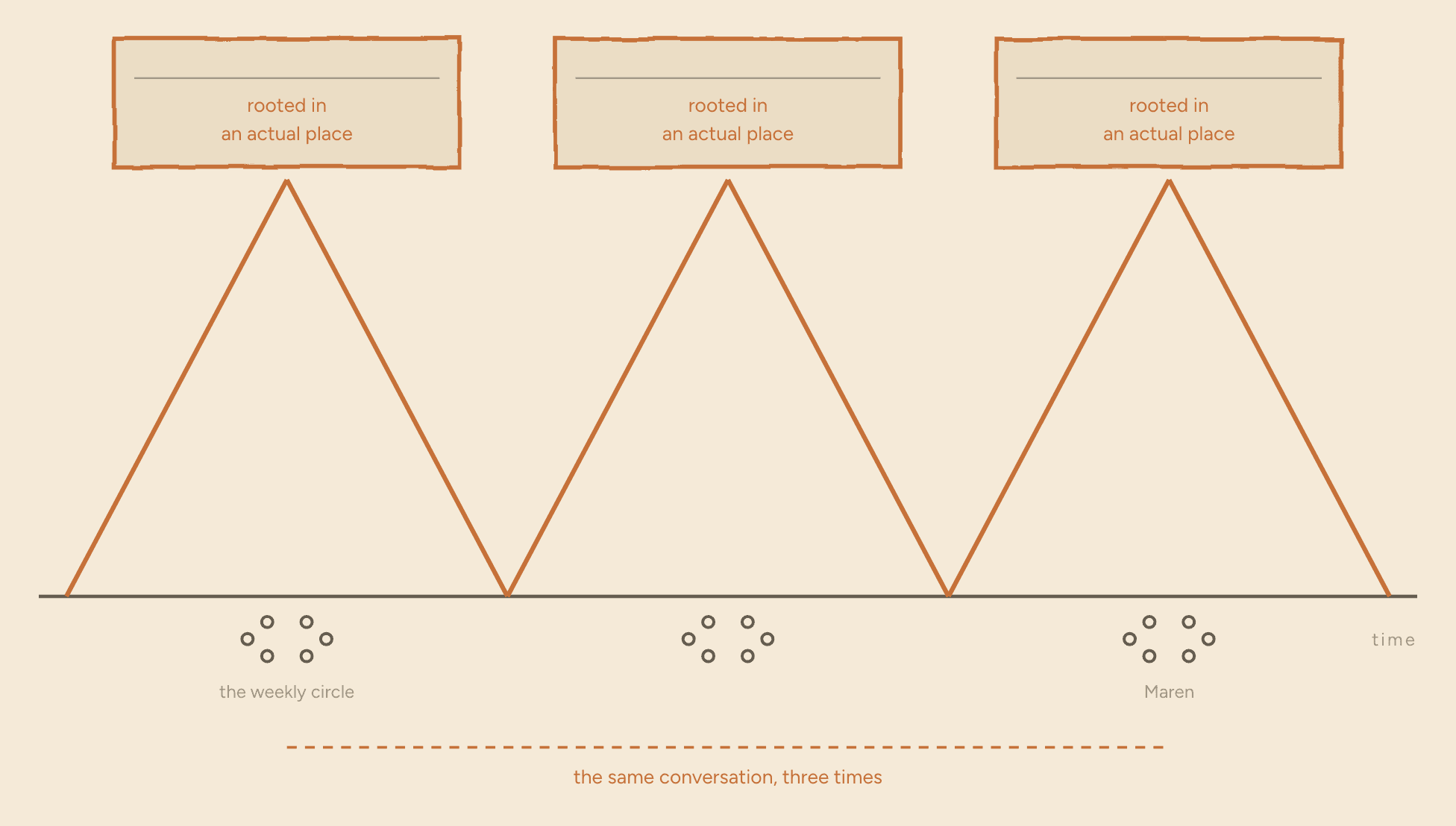 The same insight, reached and lost, reached and lost.
This isn't unusual, for us or for most organizations. It is close to the normal outcome.
What compounds, and what doesn't
The people in the room did learn something: individual understanding compounds. What doesn't compound is our shared understanding, which has nowhere to live except in the people who were present.
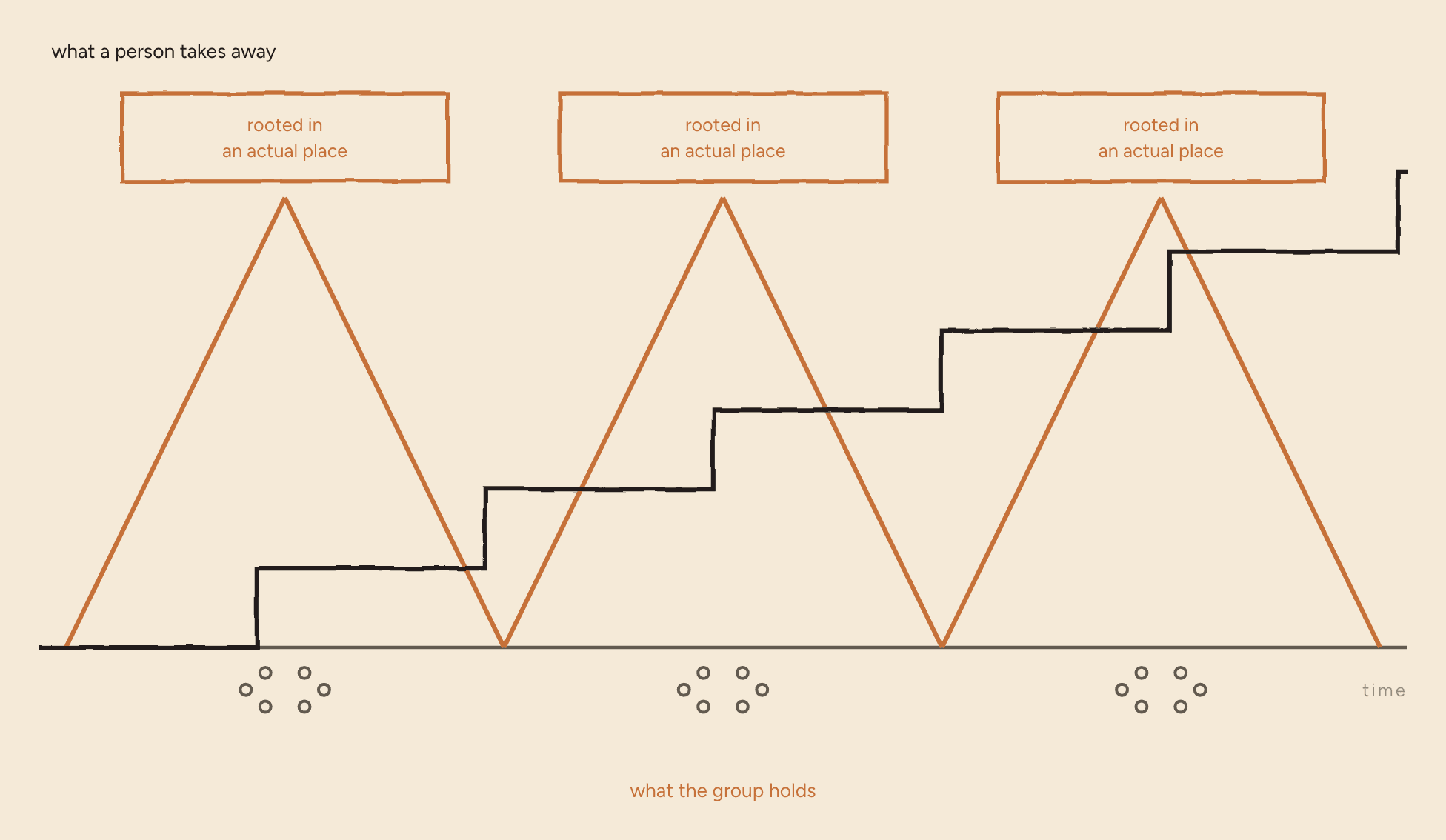 One line climbs and holds. The other keeps returning to zero.
Agreement that survives only in the people who were there is close to rumour.
No address
So where was Maren's comment supposed to go?
The forum files things by date, not by what they are about. Writing it all up properly doesn't help either: the movement has six or seven white papers, nearly a hundred thousand words. But a claim buried in a paragraph on page forty has no address. You can't point at it, so you can't disagree with it precisely or improve it. A vague objection to a long document is one nobody can act on, so in the end nobody makes it.
That means the most valuable thing a newcomer brings, a specific suggestion or disagreement, is the thing we are least able to receive.
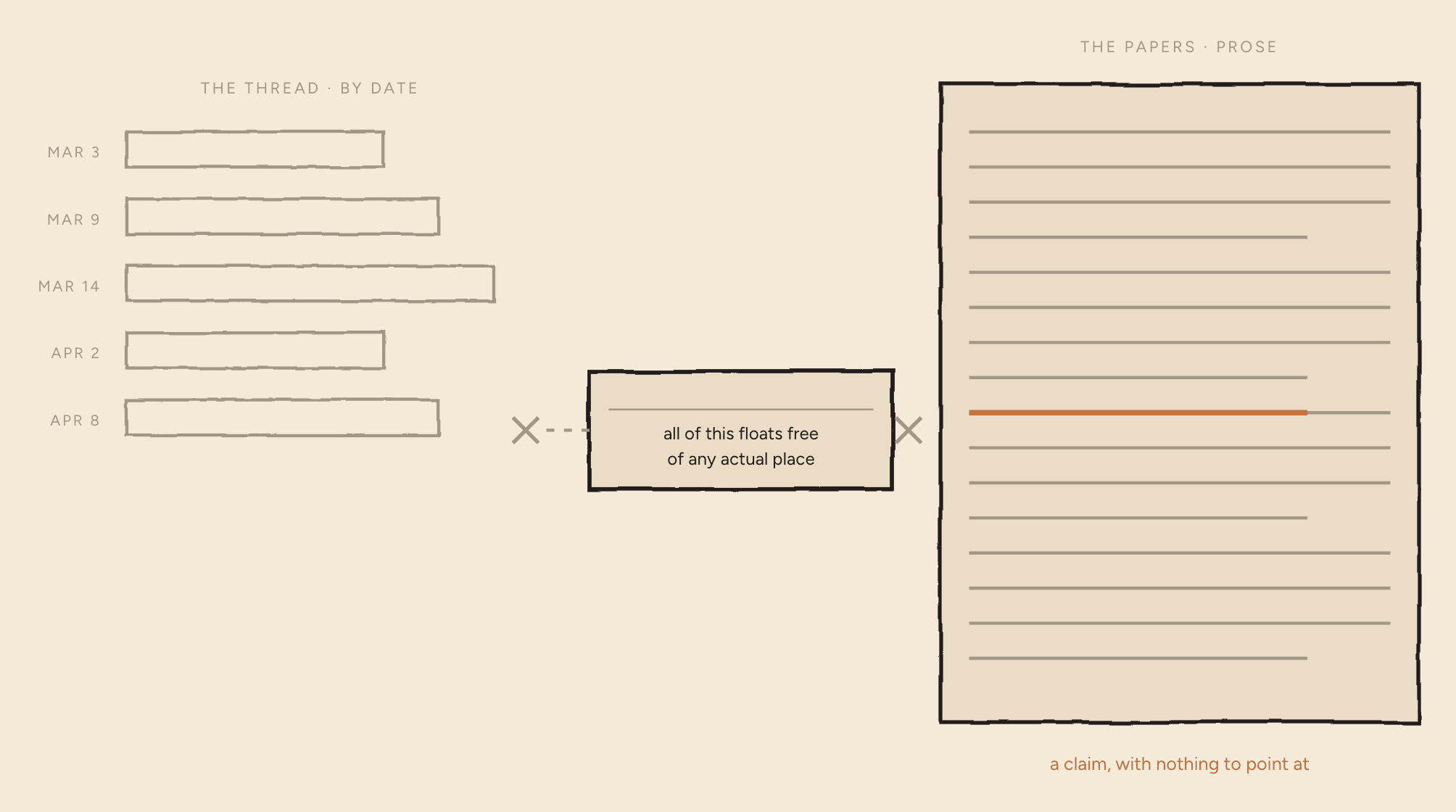 Two filing systems, neither of which has a slot for a single precise claim.
A tree of claims
What if the thing we hold in common was not a set of documents or a pile of forum posts, but a structure underneath them: a tree?
A tree helps you structure a thesis. Its root is the top claim. You break that into the sub-claims it depends on, and those into theirs, as far down as is useful. Now every claim has a location. You can also see how each claim supports the ones above it, because the links are claims too: this one is necessary for that one. What you are looking at is not just the conclusions but the reasoning behind them.
Earlier this year we did this for the Second Renaissance, drawing its strategy out of its own written corpus.
The goal tree says eight things have to be true at once for a Second Renaissance to be more than an idea: people understanding the crises as one crisis, small dense groups making the new way of living livable, and six more.
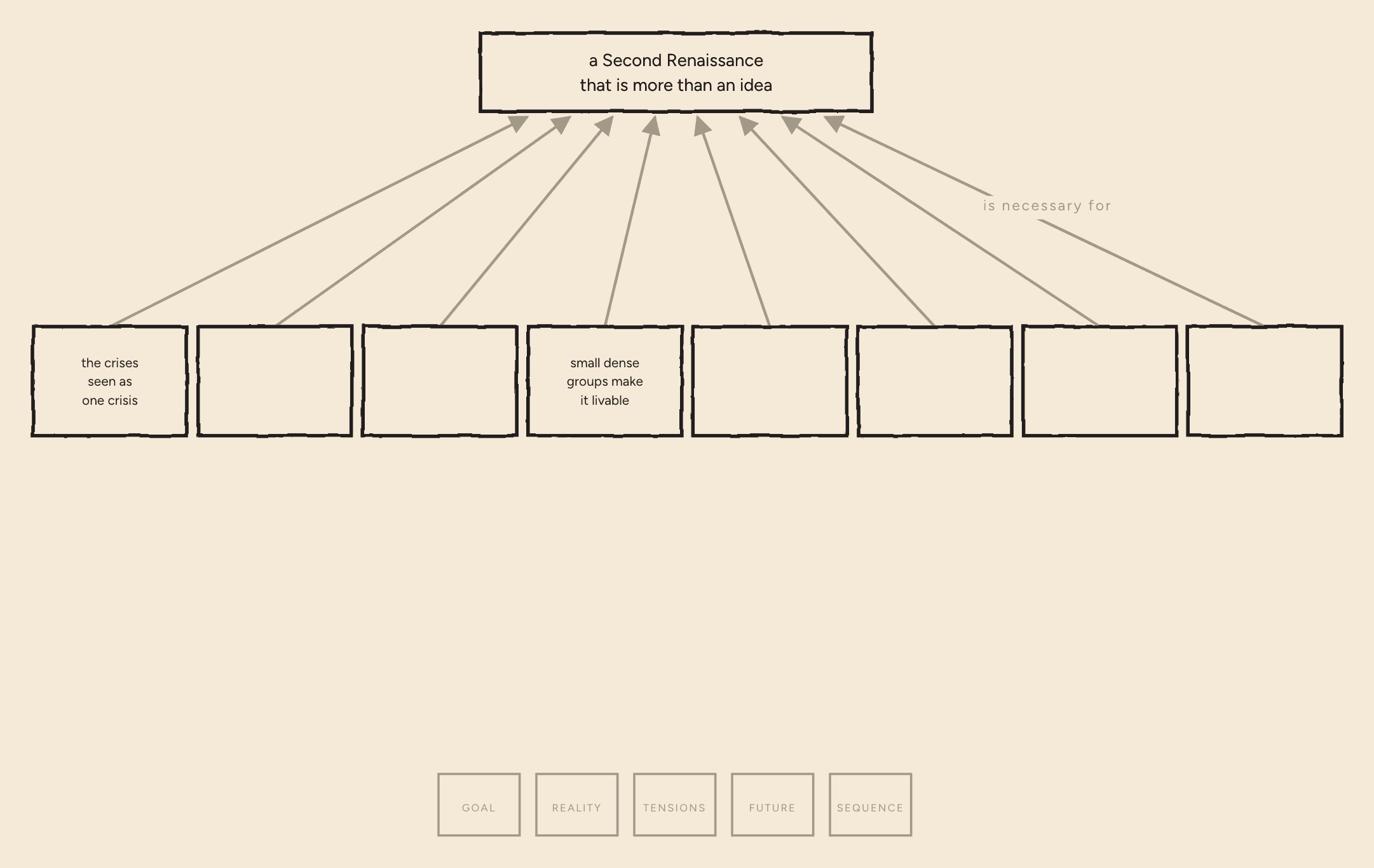 A map where every claim, and every link between claims, is something you can point at.
A destination for the disagreement
Now Maren's suggestion has somewhere to go. She is saying the tree is missing something: small, dense groups only make a new way of living livable if they are rooted in an actual place. That is a proposed new condition, hanging under one of the eight, and anyone can see exactly what it would change. Her disagreement gets sharper, too. She doesn't have to reject the whole strategy, only argue that one condition is missing.
 Her comment becomes a proposed missing condition under one of the eight, not an objection to the whole strategy.
The catch: structure takes effort
So why don't we already work like this?
Because structure takes effort. To move a single claim on those maps today you would read five diagrams, learn their grammar, find your point among a hundred boxes, then defend it to the people who drew them.
Each step is reasonable. Together they are far too much, especially for new contributors, the people we most want to welcome. Maren is not going to do the filing. She has a dissertation to write.
 Four reasonable requirements between a newcomer and the map. Most people stop at the bottom.
A dilemma, and the assumption behind it
Every group that tries to give itself structure runs into this. People want the conversation to be accessible, easy and joyful. Nobody joined a movement for civilizational renewal to fill in forms. But accumulation needs structure: if everything stays loose, the good parts dissolve into the scroll and we have the same conversation again two months later.
It looks like a dilemma: keep it accessible, or make it structured so it cumulates.
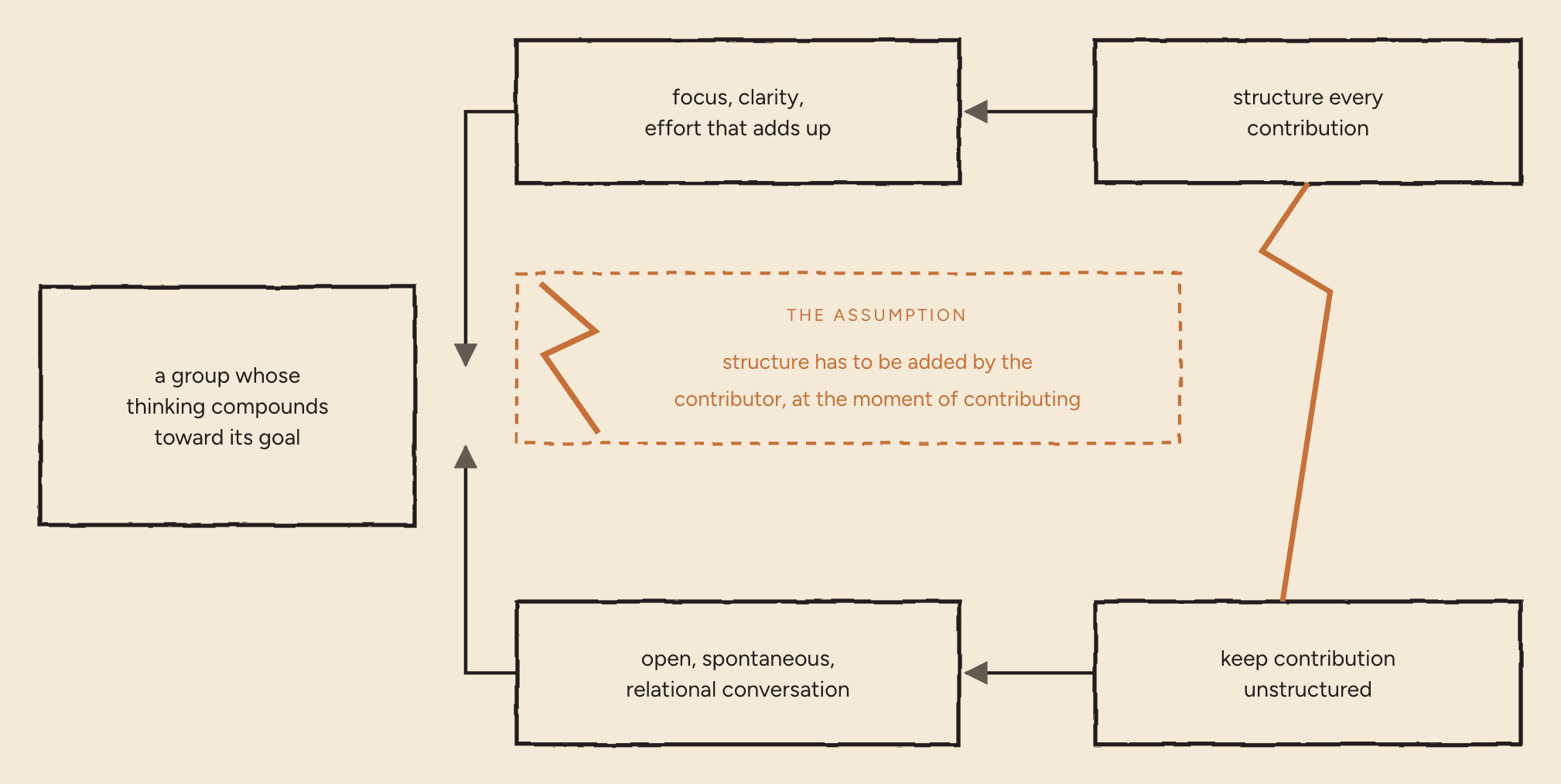 Both sides want the same outcome. One shared assumption is what makes their actions look incompatible.
Both sides serve the same goal, so rather than pick one, look for the assumption that makes them look opposed: the structure has to be put there by a person, probably the person contributing, at the moment they contribute.
That assumption is no longer true in the age of AI. That is what makes a reason commons possible: a shared, living tree of a group's reasoning that anyone can add to just by talking.
Separate the acts
So let the conversation be a conversation. Maren posts her comment where she was going to anyway.
Afterwards, separately, AI reads the thread against the tree and proposes where things belong: this sentence supports that condition, this one challenges that link, this one is a claim the tree has nowhere to put yet.
Then a person or a small group, with AI assistance where it helps, decides what actually merges into the tree. It's pull requests for discourse 🙂
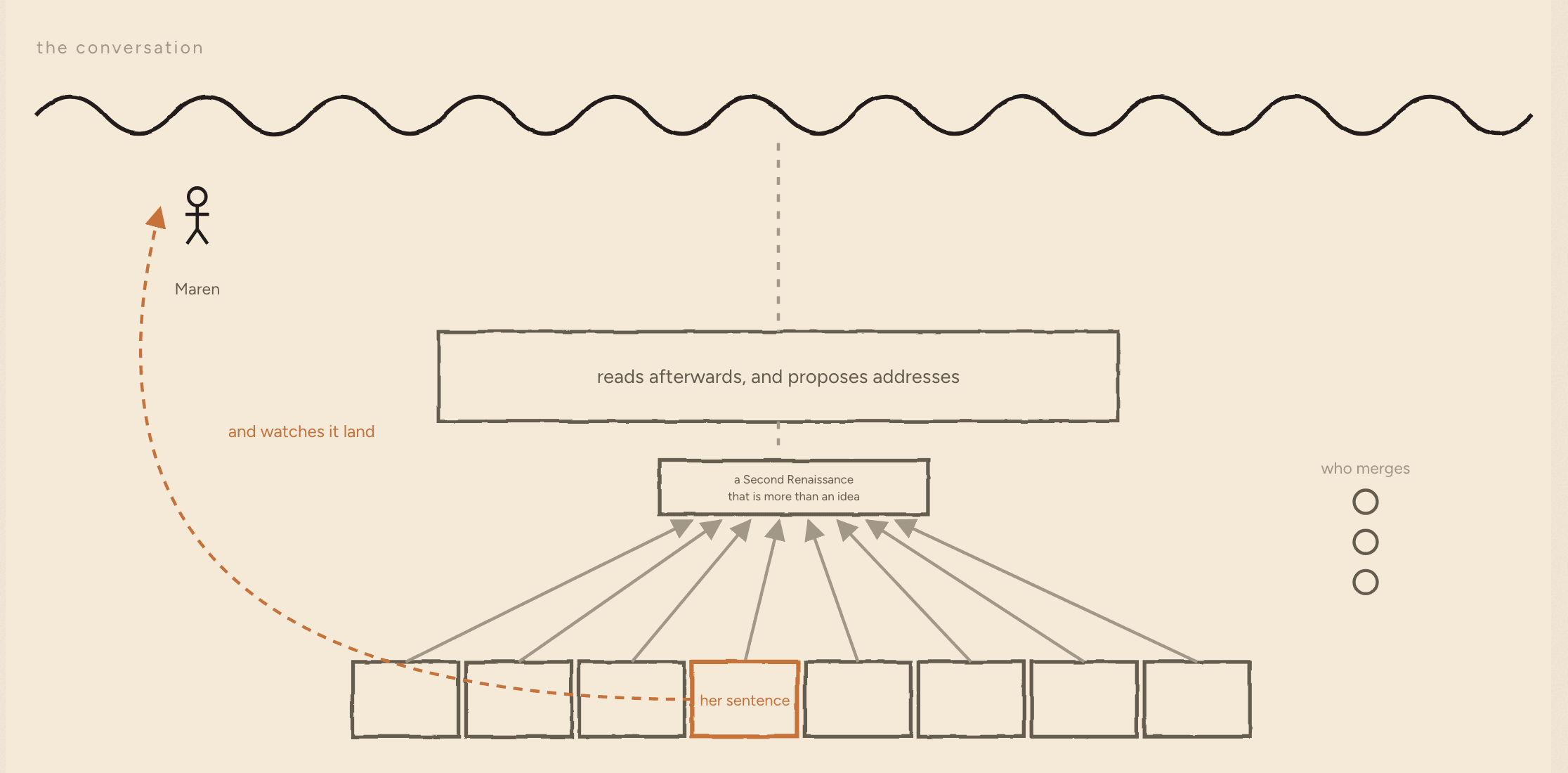 Contributing and filing are pulled apart: she talks, AI proposes, people decide, and her sentence lands at an address she can find again.
The cost of contributing stays what it always was: writing on the forum. The filing still gets done, just not by the contributor, and AI is what makes that affordable.
Her sentence ends up attached to the claim about small, dense groups, with her name on it. She hasn't joined a committee or learned a notation, and her point is now part of what the movement is weighing, where anyone can find it.
It works the other way, too
The tree can also feed the forum. A new post that touches a claim could get a quiet note, "related: see the earlier threads on this", so the next person knows the ground has been covered. The research circle wouldn't have needed its third pass.
And the same eight conditions that tell Maren where her suggestion belongs tell everyone which one nobody is working on.
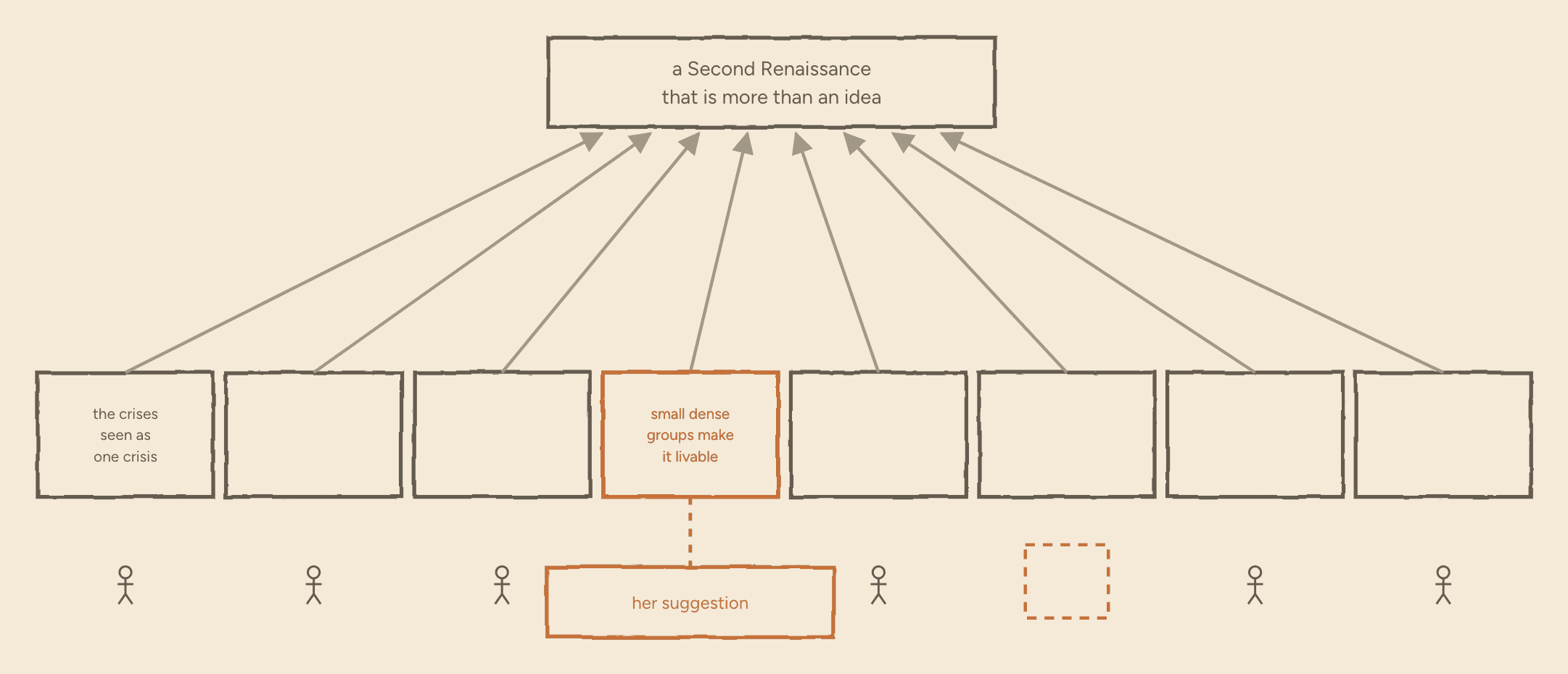 The same structure that routes a newcomer's comment also shows the movement where its attention isn't.
None of this is finished. The trees are provisional and wrong in places, the AI reader is a prototype, and the merge rules are a draft. The trees are public anyway.
Some readers will feel a renewal is something that emerges, not something you plan. We'd agree. But good gardeners still plan, and use reason to improve what they do. That is what we are trying here: to cultivate a commons for reason, where better sensemaking can grow.
So find the claim you disagree with. Or find the one nobody is working on.
Sources and method
The five trees (goal, current reality, conflict resolution, future reality, prerequisite) exist as written documents and are the source of every diagram in this piece; nothing here is an invented illustration. The eight conditions are the critical success factors of the goal tree. The symptom quoted is the first undesirable effect of the current reality tree. The dilemma between free conversation and structure, and the assumption holding it together, are redrawn from the working conflict-resolution diagram.
Maren is a composite, written for this piece. She is not a member of the community and her comment is not a quotation; both are drawn from the kind of suggestion the trees are least able to receive today. The research circle is real and meets weekly; the repeated conversations are a pattern rather than dated events.
The reading and merging described are a working prototype, not a finished system. The matching is not yet good enough to run unattended, and the merge rules exist only as a draft. They are written here as what the structure makes possible.
The drawings on this page are stills from the scrolling version, where they build up a step at a time.
